These are the Income-tax Act's numbers, not ours. The fee is fixed — the interest keeps running.
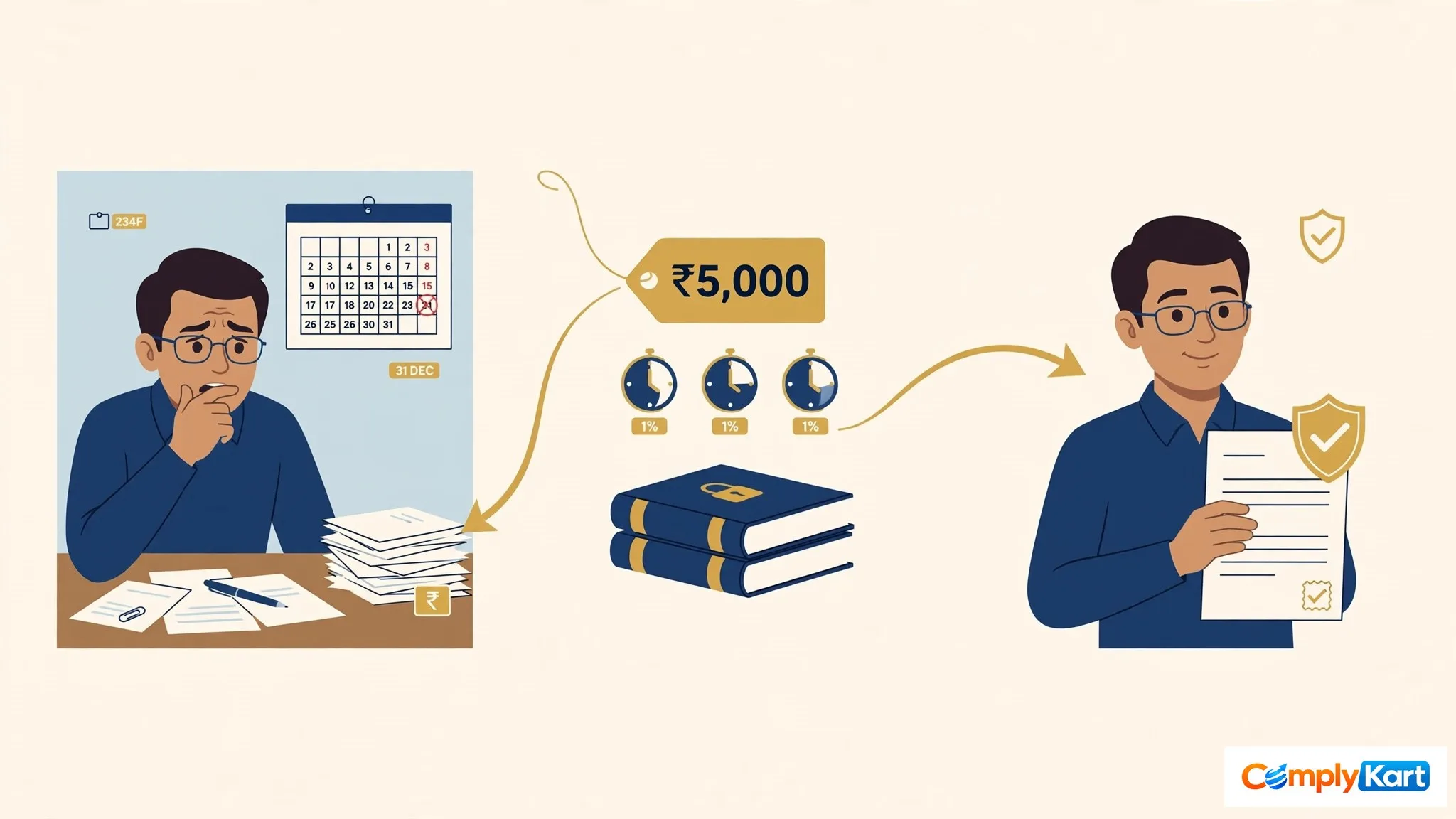
Late filing fee (234F)
₹5,000
Flat fee for filing after the due date. Reduced to ₹1,000 if your total income is ₹5 lakh or less.
Interest on unpaid tax (234A)
1% per month
On the tax still unpaid after the due date — every month or part of a month counts.
Advance tax interest (234B/234C)
1% per month
Shortfall in advance tax instalments attracts its own interest, on top of 234A.
Losses you can't carry forward
Lost for 8 years
Business and capital losses can only be carried forward if the return is filed on time. Miss the date, lose the set-off.
Put it in perspective: Filing even one day late costs a minimum ₹5,000 in fees alone — before a rupee of interest.
After you pay
What happens after you pay
Five steps, no guesswork — you always know exactly what comes next. Tap a step to see what it involves.
12345
You pay securely. Payment is confirmed instantly, and your receipt with the written fee breakup lands in your inbox.
The short answer. For Assessment Year 2026-27, the standard ITR due dates were 31 July 2026 for individuals and HUF not under audit, and 31 August 2026 for non-audit business and professional returns.
Dates that matter right now. Audit cases — companies and section 44AB audits — file by 21 November 2026, extended by CBDT Circular 07/2026. Missed your deadline? A belated return can still be filed till 31 December 2026, with the section 234F late fee. Corrections stay open longer: a revised return can be filed till 31 March 2027, though the section 234-I fee applies to revisions made after 31 December 2026.
Overview
Every year, crores of Indians file an income tax return. Most of them do it in the last ten days of July, many of them discover a mismatch they didn't expect, and a good number pay more tax than they needed to — not because the law is unfair, but because nobody explained the choices clearly.
An income tax return is your annual statement to the Income Tax Department: what you earned, what you saved, what was deducted, and what you still owe — or what the government owes you back. For Assessment Year 2026-27, which covers income earned between 1 April 2025 and 31 March 2026, the return is filed under the Income-tax Act, 1961. The new Income-tax Act, 2025 takes over for income earned from 1 April 2026 onwards, so this is the last full filing season under the old Act's familiar section numbers — with the new Act's renumbered provisions waiting on the other side.
Filing is not just a legal formality. Your ITR is the document banks ask for when you apply for a home loan, embassies ask for when you apply for a visa, and the tax department itself uses when it decides whether to scrutinise you. A clean, consistent filing history is one of the quietest assets a person can own.
Who must file — and who should file anyway
Filing is mandatory if your gross total income (before deductions) exceeds the basic exemption limit: ₹2.5 lakh for most individuals, ₹3 lakh for senior citizens (60–80), ₹5 lakh for super senior citizens (80+) under the old regime. Under the new regime, the basic exemption is ₹4 lakh for FY 2025-26.
It is also mandatory in specific situations even if your income is below the limit: if you deposited more than ₹1 crore in current accounts, spent more than ₹2 lakh on foreign travel, paid electricity bills above ₹1 lakh in a year, or are a beneficial owner of foreign assets. Companies and firms must file regardless of income or loss.
Then there is the larger group — people who are not strictly required to file but should. If any TDS was deducted from your salary, interest, or freelance payments, the only way to get it back is a return. If you want a home loan, a business loan, or a Schengen visa, three years of ITRs is standard documentation. If you carried forward a capital loss or business loss, filing on time is the only way to preserve it. The return costs you nothing to file yourself and a modest professional fee if you don't — the refund it brings is often many times that.
The form maze: ITR-1 through ITR-7, decoded
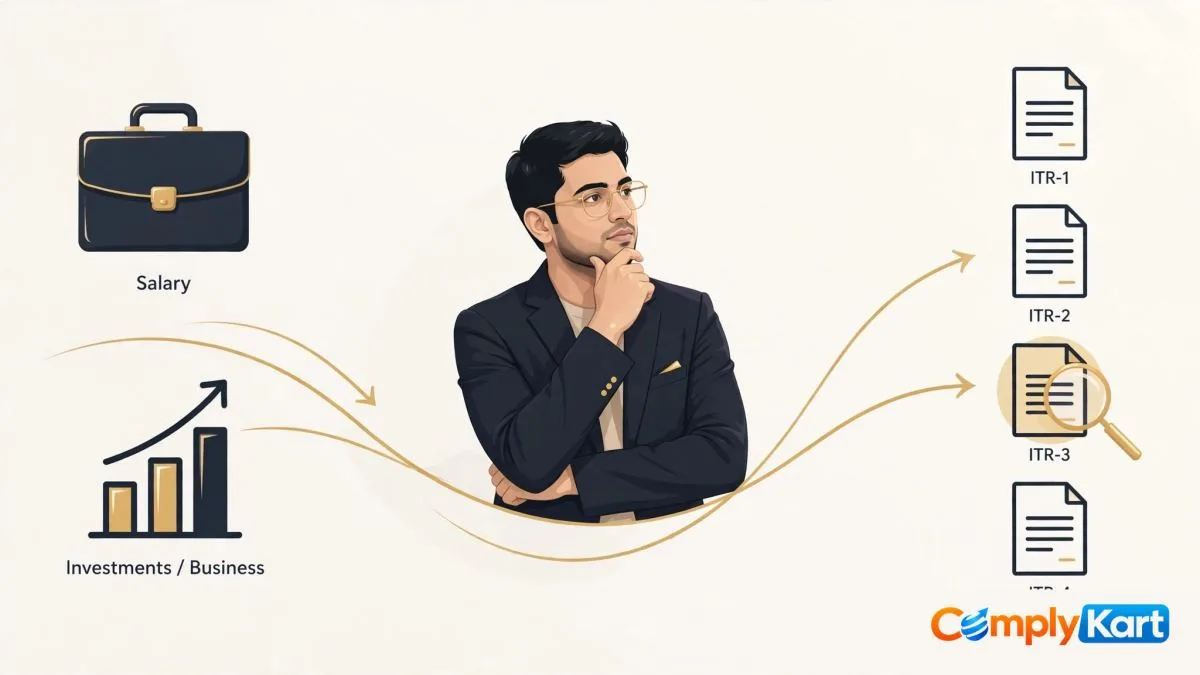
Picking the wrong form is the single most common filing error, and the portal will not always stop you. Here is the map:
ITR-1 (Sahaj) — for resident individuals with total income up to ₹50 lakh from salary or pension, one house property (expanded to two house properties from AY 2026-27), and other sources like interest. You cannot use ITR-1 if you have capital gains beyond the small LTCG window (up to ₹1.25 lakh under Section 112A is now permitted), foreign assets, or business income.
ITR-2 — for individuals and HUFs who don't have business or professional income but don't fit ITR-1: capital gains, more than one house property, foreign assets, RNOR/NR status, or income above ₹50 lakh.
ITR-3 — for individuals and HUFs with income from business or profession, including presumptive cases that opt out. If you freelance, consult, trade, or run any business as an individual, this is usually your form.
ITR-4 (Sugam) — for presumptive taxation: businesses under Section 44AD (turnover up to ₹2 crore, or ₹3 crore with 95% digital receipts), professionals under 44ADA (up to ₹50 lakh, or ₹75 lakh with 95% digital receipts), and transporters under 44AE. Total income must be within ₹50 lakh.
ITR-5 — for firms, LLPs, AOPs, BOIs, and other persons not covered elsewhere.
ITR-6 — for companies other than those claiming exemption under Section 11 (charitable trusts file ITR-7).
ITR-7 — for trusts, political parties, institutions, and universities claiming exemption.
File in the wrong form and the return is defective under Section 139(9). The department will ask you to rectify within 15 days, and until you do, the return is treated as never filed.
Old regime vs new regime: the decision that saves real money
Since FY 2023-24, the new regime under Section 115BAC is the default. You have to actively opt for the old regime. For FY 2025-26, the new regime's maths changed significantly:
Total income
New regime rate (FY 2025-26)
Up to ₹4,00,000
Nil
₹4,00,001 – ₹8,00,000
5%
₹8,00,001 – ₹12,00,000
10%
₹12,00,001 – ₹16,00,000
15%
₹16,00,001 – ₹20,00,000
20%
₹20,00,001 – ₹24,00,000
25%
Above ₹24,00,000
30%
The headline: Section 87A gives a rebate of up to ₹60,000, which wipes out the entire tax on income up to ₹12 lakh. Salaried taxpayers get a standard deduction of ₹75,000 on top, so a salary of ₹12.75 lakh effectively pays zero tax. If your income lands just above ₹12 lakh, marginal relief caps the extra tax at the amount by which you crossed the threshold — no cliff.
The old regime keeps its familiar slabs (nil to ₹2.5 lakh, 5% to ₹5 lakh, 20% to ₹10 lakh, 30% above) with the ₹50,000 standard deduction and the full menu of Chapter VI-A deductions: 80C (₹1.5 lakh), 80D (health insurance), HRA, home loan interest under Section 24, and NPS under 80CCD.
The rule of thumb: if your total deductions exceed roughly ₹4–5 lakh, run the old-regime numbers. Below that, the new regime usually wins. But "usually" is doing a lot of work in that sentence — capital gains, rental income, and professional expenses can flip the answer. We compute both, every year, for every client. It takes minutes and it is the highest-ROI exercise in personal tax.
One caution: the regime choice interacts with business income. If you have business income and opt out of the new regime, you can only switch back a limited number of times. Individuals with only salary income can flip every year. Get this wrong and you're locked in.
What you need before you start
Gather these before anyone touches the portal:
PAN and Aadhaar (linked — unlinked PANs attract higher TDS and portal blocks)
Form 16 from each employer (and Form 16A for TDS on interest, rent, professional fees)
Form 26AS, AIS, and TIS — download all three and reconcile; AIS now captures securities transactions, mutual funds, and high-value spending the old 26AS never showed
Bank statements for all accounts, including interest certificates
Capital gains statements — broker P&L, mutual fund statements; the AIS now reports these, so the department already knows
Deduction proofs — 80C investments, 80D premiums, HRA rent receipts, home loan interest certificate, NPS contributions, donations (80G receipts with registration numbers)
Business books — if applicable: profit & loss, balance sheet, GST turnover reconciliation
The AIS/TIS reconciliation deserves emphasis. Since 2021, the department's Annual Information Statement shows far more than your Form 16: share trades, mutual fund redemptions, property deals, even large credit card spends. If your return omits income the AIS shows, you will get a notice. We reconcile all three statements line by line before filing — it is the single best defence against scrutiny.
The filing process, step by step
Step 1: Choose the regime and the form. Compute tax under both regimes. Confirm the ITR form based on income sources and residential status.
Step 2: Reconcile your data. Match Form 16 with 26AS, AIS, and TIS. Resolve every mismatch — a TDS credit missing from 26AS, a capital gain in AIS you forgot about, interest the bank reported but you didn't.
Step 3: Compute total income. Salary, house property, business, capital gains, other sources — each with its own rules. Set off losses as permitted (intra-head and inter-head, within the ₹2 lakh cap for house property loss against other heads).
Step 4: Apply deductions and compute tax. Chapter VI-A deductions for old regime; standard deduction where applicable. Add 4% health and education cess. Check surcharge thresholds.
Step 5: Pay self-assessment tax. If tax remains payable after TDS/TCS and advance tax, pay it before filing. Interest under Sections 234A/B/C runs on unpaid amounts.
Step 6: File on the portal. Upload the return on incometax.gov.in — JSON utility or online form. Validate, submit, and note the acknowledgement number.
Step 7: E-verify within 30 days. Aadhaar OTP is fastest; net banking, demat, and bank EVC also work. An unverified return is an unfiled return — after 30 days it lapses entirely. Physical ITR-V to CPC Bengaluru is the fallback nobody should need.
Deadlines for AY 2026-27 — read carefully, they changed
Category
Due date
Individuals/HUF (ITR-1, ITR-2), non-audit
31 July 2026
Business/professional, non-audit (ITR-3, ITR-4)
31 August 2026 (Finance Act, 2026 — a permanent change to section 139(1), not a CBDT extension)
Audit cases (companies, 44AB)
21 November 2026 (extended by CBDT Circular 07/2026)
Transfer pricing cases (Form 3CEB)
30 November 2026
Belated return (Section 234F)
31 December 2026
Revised return
31 March 2027 (Section 234-I fee if revised after 31 December 2026)
Updated return (ITR-U)
Up to 48 months from end of AY
If you missed a year entirely, you can fix an old return with ITR-U — the updated-return route that stays open up to 48 months from the end of the assessment year, with stepped additional tax of 25% to 70% on top of the tax and interest you owe.
The 31 August date for non-audit business filers is a statutory change from the Finance Act 2026, not a one-year extension — but confirm against the current portal before relying on it.
What happens after you file
The Centralised Processing Centre in Bengaluru processes the return under Section 143(1) — usually within weeks for clean returns. You'll get an intimation: no adjustment (the happy email), a refund, or a demand. Refunds with interest under Section 244A arrive by bank transfer to your pre-validated account; keep your bank details current on the portal.
If the return is picked for scrutiny under Section 143(2), you'll get a notice — usually within months. This is not an accusation; most notices are resolved with documents. What matters is that your filing was consistent: income matching AIS, deductions backed by proofs, losses claimed only if the original return was on time.
Penalties, interest, and the cost of delay
Section 234F: ₹5,000 for filing after the due date; ₹1,000 if total income is under ₹5 lakh.
Section 234-I: ₹5,000 (₹1,000 if total income is up to ₹5 lakh) where a revised return is furnished after 31 December 2026 — revisions stay open till 31 March 2027, but they are no longer free.
Section 234A: 1% per month on unpaid tax from the due date till payment.
Section 234B/234C: interest for shortfall or deferment of advance tax.
Loss carry-forward: business losses, capital losses, and speculation losses can only be carried forward if the original return was filed on time. Miss the deadline and the loss dies with the year.
Prosecution (Section 276CC): wilful failure to file, in extreme cases — rare for honest mistakes, but the provision exists.
Common mistakes we fix every season
Filing ITR-1 when capital gains require ITR-2. Forgetting interest from savings accounts and fixed deposits (the bank reported it; the AIS shows it). Claiming HRA and home-loan interest on the same property incorrectly. Not reporting exempt income like PPF interest (exempt but reportable). E-verifying late and assuming the return was filed. Paying advance tax late and ignoring 234C interest. And the perennial one: choosing the regime by gut feeling instead of computing both.
Fees and packages
Essential — single-source income (salary + interest), ITR-1/ITR-2, AIS reconciliation, e-verification support.
Comprehensive — multiple income sources, capital gains, rental income, both-regime comparison, loss carry-forward tracking.
Business — ITR-3/ITR-4, presumptive schemes, advance tax computation, GST turnover reconciliation, audit coordination where applicable.
You get a written breakup — professional fee, government charges, and taxes shown separately — before anything is filed. No surprises after you pay.
How ComplyKart helps
We don't just "file your ITR." We reconcile your AIS, TIS, and 26AS before anything is entered. We compute both regimes and show you the difference in rupees, not adjectives. We track your carried-forward losses year to year so they don't silently lapse. And if a notice arrives in October, we're the ones who answer it — because we filed the return, we know exactly what's in it.
What we won't do: promise a refund figure before we've seen your documents, file in the wrong form to save time, or skip the AIS reconciliation because the deadline is close.
Sources
CBDT Circular No. 07/2026 (28 Sept 2026); Finance Act 2025; Finance Act 2026 (s.139(1) amendment — verify); CBDT Notification No. 45/2026 (ITR forms AY 2026-27); incometax.gov.in utilities and FAQs. Reviewed October 2026. Due dates and thresholds change yearly — check the current CBDT circulars before filing.
ITR filing — questions we hear every July
You pay for our expert's time — document checking, filing, follow-ups — not the government. The government fee goes to the government; our fee is for the work we do so you don't have to figure it out yourself.
Salary plus one house property and interest income: ITR-1. Capital gains, foreign assets, or more than one house property: ITR-2. Business or professional income: ITR-3 (regular books) or ITR-4 (presumptive). Filing the wrong form gets your return marked defective — the form has to match your income sources, not your preference.
Three things, all automatic. A flat ₹5,000 late fee under section 234F (₹1,000 if your income is under ₹5 lakh). Interest at 1% per month on unpaid tax under 234A. And you lose the right to carry forward business and capital losses — except house property loss — for up to eight years. The belated return window stays open till 31 December, but the costs don't reverse.
There is no universal answer; it depends on your deductions. The new regime (115BAC) has lower slab rates and is now the default, but you give up most deductions — 80C, 80D, HRA, home-loan interest. If your deductions are small, the new regime usually wins. If you max out 80C, carry HRA, and pay home-loan interest, run both computations. We compute both for every client before filing — it takes minutes and the difference is often five figures.
Don't file on the Form 16 alone. Reconcile all three — AIS, TIS, and 26AS — against your own records first. Mismatches usually come from TDS deposited late by the deductor or reported under the wrong section. File on reconciled numbers; if a mismatch can't be resolved before the deadline, disclose it correctly in the return rather than hiding it. Unreported AIS entries are the single most common trigger for scrutiny notices.
No. Any capital gains — equity, mutual funds, property, crypto — pushes you to ITR-2 at minimum. ITR-1 explicitly bars capital gains income. This is the most common form error we correct each season: salaried filers with a few lakhs of equity gains filing ITR-1 out of habit, then receiving a defective-return notice under section 139(9).
Not necessarily. Most notices are automated — a 143(1) intimation is just the department's computation versus yours, and a mismatch notice often traces to TDS or AIS differences, not evasion. Read what the notice actually asks for, gather the supporting documents, and respond within the timeline on the notice. Ignoring it is what turns a routine query into a real problem.
What clients say about working with us
Real stories from businesses we've worked with.
Trademark Registration“
Our Trademark was applied in all the classes with a short span of time by Complykart Trademark Experts and I can say the level of expertise and commitment they carry is remarkable. It's an A+ from my side. We are now sticking to ComplyKart only.
Company Registration“
I found the professionalism of the staff at complykart.com, a pleasure to work with. As a foreigner to India, they took the time to explain the documentation and assisted in every question I raised. I was pleased that complykart.com made it easy for my Business.
Merger & Acquisition“
Trust, Commitment, Dedication and responsiveness are the best things with ComplyKart. Thanks for handling our Merger assignment with so much care. After my business disputes, complykart handles all things with own sense of understanding.
Direct Tax Specialist · Income Tax & TDS · 8+ years experience
Ritik Gupta handles ComplyKart’s direct tax practice — income tax returns for companies, LLPs and individuals, TDS filings, advance tax planning and assessment proceedings. He keeps clients penalty-free through every assessment year.
Last reviewed: 16 November 2026
Get a free consultation
Talk to a ComplyKart professional about Income tax Return filing. The first consultation is free.